The short answer
The Dragon, Tiger, Bird and Tortoise have cardinal associations in Chinese symbolism. Form School also uses animal imagery to discuss support around a viewpoint. Keep fixed compass directions separate from relative front, back, left and right when reading a diagram.
Four animals with cardinal associations
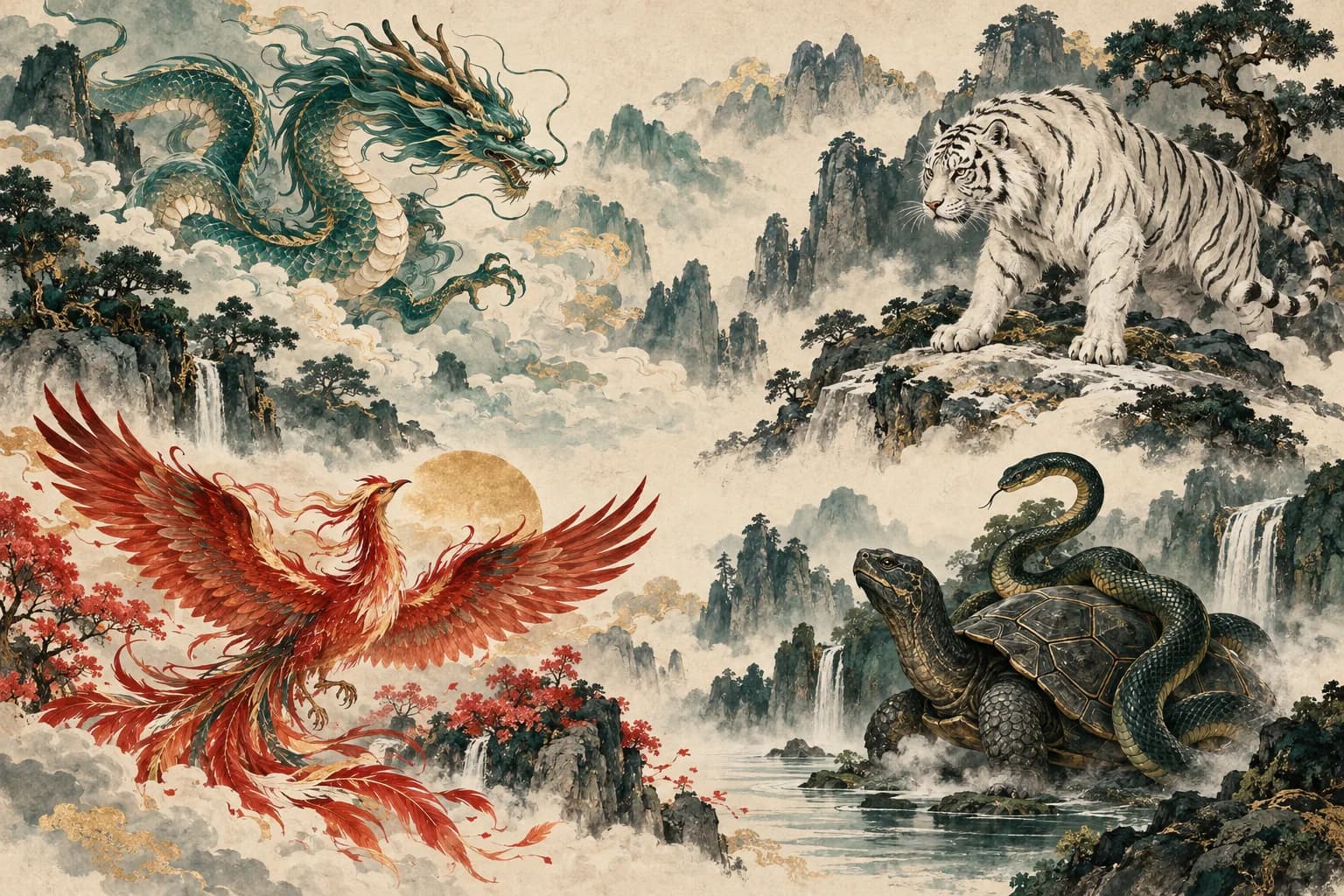
A Metropolitan Museum mirror record identifies the dragon with East, tiger with West, bird with South, and the entwined tortoise and snake with North. This is evidence of the symbolism in an historical object. It does not, by itself, tell us how a particular apartment should be furnished.
Background: The Metropolitan Museum of Art — Mirror with Symbols of the Four Cardinal Directions
A compass frame and a viewpoint frame
If a person faces South, East is to their left and West to their right. That relationship helps explain a familiar left-dragon, right-tiger presentation. But if the viewpoint changes, a relative left and right must not be silently treated as fixed East and West. State the frame of reference.
Form School teaching also uses the animal imagery as an analogy for support around a site: shelter behind, forms at the sides and an open area in front. This product’s backing rule is a limited indoor adaptation. A wall behind a chair is geometry; calling it a tortoise or mountain is the traditional analogy.
Background: Ole Bruun — Cosmological Principles, Schools and the Feng Shui Compass
An apartment is not a miniature mountain valley
A large site reading includes terrain and surrounding forms that cannot be represented by one furniture rectangle. Indoors, the practical questions are narrower: Is there support behind the seat? Can the person see the entrance? Is the route usable? These observations can be checked without asserting that every room reproduces an ideal landscape.
Avoid using a decorative animal image as a cure for a missing physical condition. A picture of a tortoise does not move a wall behind the chair or create space at an exit. If a practitioner recommends imagery for symbolic reasons, that recommendation should be distinguished from changes to the layout itself.
Reading diagrams without reversing the directions
Maps may be North-up or South-up. A correctly labelled South-up chart puts East on the left and West on the right. An artist may arrange the animals for visual balance rather than navigation. That is why this page supplies a text table instead of asking the generated illustration to carry verified directions.
A further ambiguity is the term Four Symbols itself: Chinese cosmological writing can also use it for four combinations of yin and yang lines. The animals and those line combinations are related vocabularies, but they are not identical pictures. Identify the usage before reading a diagram.
| Creature | Direction |
|---|---|
| Azure/Green Dragon · Qinglong 青龙 | East |
| White Tiger · Baihu 白虎 | West |
| Vermilion Bird · Zhuque 朱雀 | South |
| Black Tortoise and snake · Xuanwu 玄武 | North |
A desk facing East: left and right no longer mean East and West
Picture a chair at a desk facing East. In this viewpoint, the sitter’s left lies toward North, the right toward South, and the back toward West. If someone describes a supporting form on the left as Dragon, that relative description cannot simultaneously be read as the fixed eastern cardinal animal. One is a viewpoint analogy and the other is compass iconography. Identifying the frame explains the apparent disagreement.
Now inspect the chair’s actual backing. A solid wall behind it can represent an indoor adaptation of the support metaphor. A high bookcase drawn nearby is a separate object with a footprint, access requirements and real construction. The metaphor does not determine whether the bookcase is appropriate or whether it creates another practical concern. A small tortoise ornament on the desk belongs to symbolic decoration, rather than supplying physical backing.
Turn the desk in the plan and compare again. Relative front and back move with the sitter, while North and East remain tied to the confirmed plan orientation. You can now explain which relationship changed and which directional association stayed the same. This is a reproducible way to read an indoor example without pretending that an apartment contains the same landforms as a sheltered site in a mountain landscape.
A way to work through it
- Write down whether the diagram uses cardinal directions or a person’s viewpoint before locating the four animals.
- Mark the sitter’s facing direction and label front, back, left and right relative to that position.
- Check the actual support and access on the plan; keep animal ornaments and broader site symbolism in their own context.
Try an observation
Look at the homepage South-up compass, then the North-up plan. Locate East in each. The screen position changes; the named direction does not.
Common questions
Which directions do the four celestial animals represent?
The Azure or Green Dragon is associated with East, the White Tiger with West, the Vermilion Bird with South, and the Black Tortoise with North. The northern image can include an entwined snake. These cardinal associations are documented by the museum object linked below.
Are Dragon left and Tiger right always correct?
That arrangement can make sense from a South-facing viewpoint, where East is left and West is right. Relative form descriptions require their own viewpoint. If a person faces another direction, their left and right change while the fixed cardinal associations do not.
Is the Black Tortoise the same as a wall behind my chair?
A wall is an observable indoor backing condition. Calling it a tortoise or mountain is an analogy used in a particular spatial interpretation. The historical animal symbol, a terrain formation and a furniture backing rule operate at different scales and should not be treated as identical objects.
Do I need four animal statues for good Feng Shui?
This guide does not prescribe statues. First understand whether the advice concerns historical imagery, a site’s surrounding forms or a seat’s support. Decorative objects can have cultural meaning, but their presence does not create a wall, confirm a direction or clear an access route.
Sources & further reading
- The Metropolitan Museum of Art — Mirror with Symbols of the Four Cardinal Directions
Museum record documenting the four animals and their cardinal associations.
- Ole Bruun — Cosmological Principles, Schools and the Feng Shui Compass
Cambridge chapter summary documents diverse interpretations of qi, dragon, tiger, Bagua and Five Elements. Full chapter access may require a library subscription.
Historical and traditional interpretations are distinguished from observable layout conditions. Worked examples are illustrative editorial scenarios, not documented client cases. Practical examples and product-scope explanations are editorial applications, not quoted source text. School conventions vary; these articles do not predict health, wealth or personal outcomes.